
A turbulent century - Beaumonts in the 1600s
The first three years of the 17th century opened with Queen Elizabeth reigning supreme after 44 years. When she died childless in 1603 her cousin James, King James VI of Scotland (still separate then), succeeded to the English throne.
In Coleorton Sir Henry Beaumont was Lord of the manor having succeeded his father Nicholas Beaumont in 1585. Henry was a member of parliament, Justice of the Peace for Leicestershire and an assize judge. He drew a good income from his coal mines in and around Coleorton and in 1600 his annual income was estimated as £1500 (over half a million pounds today). He was knighted by King James on his journey south from Scotland in 1603 to take the English throne.
Henry died in 1607 and he is interred in St Mary’s Church, Coleorton along with his wife Elizabeth who died a year later. The tomb is a magnificent structure in the south aisle of St Mary’s.
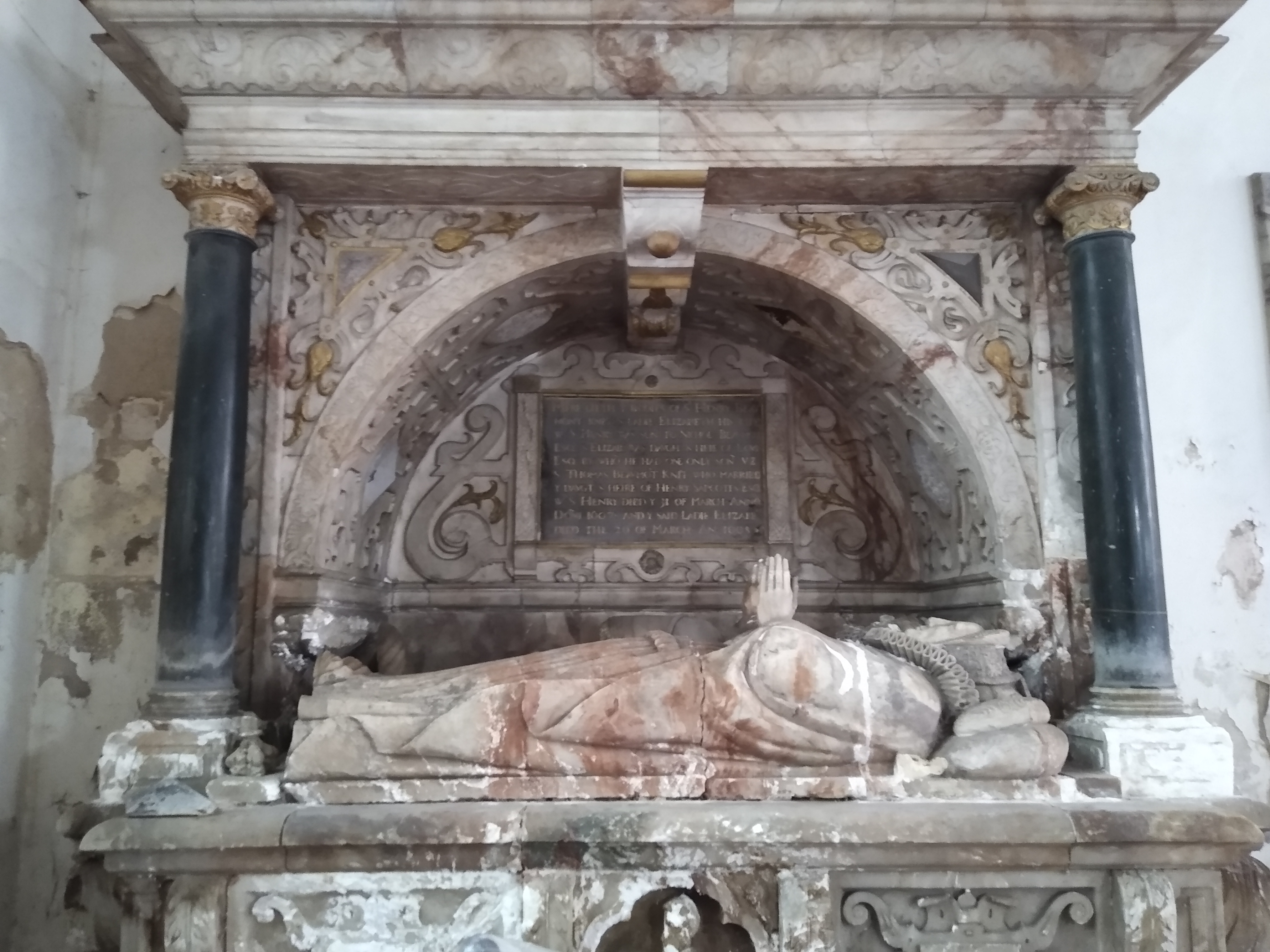
Tomb of Sir Henry and Elizabeth Beaumont at St Mary’s Church, Coleorton
The next Beaumont at Coleorton was Henry’s son Thomas, who was knighted by King John a few days after his father. Thomas was a somewhat different character and got into serious debt and was saved a few times through his family’s connection with George Villiers, a favourite of King James. In 1618 he and his wife Elizabeth hosted a masque “The Fairies Farewell” at Coleorton Hall in celebration of the recent marriage of their friend Sir William Seymour to Lady Frances Devereux, sister of The Earl of Essex. He was made 1st Baronet of Coleorton and later 1st Viscount Beaumont of Swords (Swords is a suburb of Dublin). Thomas died in 1625 from injuries sustained in a duel.
The 2nd Viscount of Swords was Thomas’s son Sir Sapcote Beaumont. By this time the parliament and King Charles I were having serious issues resulting in The English Civil War (1642 – 51) which divided the country and families. Sapcote was a royalist and fortified his house at Coleorton for the King. However the parliamentarians captured it and from there attacked the royalist base at Ashby Castle just two miles away before being retaken by the royalists, who burned it to prevent it being re-used by the parliamentarians. Sapcote had gone to live in Whitwick. He died in 1658.
Sapcote’s eldest son Thomas (they weren’t very imaginative about names!) became the 3rd Viscount Beaumont of Swords. He was born at Coleorton in 1633 and must have seen a lot of the fighting at Coleorton. Thomas Beaumont, his uncle, died at the battle of Edghill in 1642 fighting for the royalists.
After King Charles I was executed in 1649 England was ruled directly by the Rump Parliament, but in 1653 Oliver Cromwell staged a coup d’etat and took control of England as Lord Protector. After his death in 1658 his son Richard took the role but was forcibly removed after a few months and Charles II brought back from exile in France to be king. He reigned until his death in 1685 and was succeeded by his son James II. This arrangement did not work well as James was a catholic and introduced catholic-friendly laws into army and civilian life. So he was overthrown and replaced by his protestant daughter and her husband William of Orange. Thomas, 3rd Viscount of Swords, was active in bringing Mary and William from Holland and installing them as joint sovereigns.
Thomas did not forget his Coleorton roots and on his death in 1702 bequeathed funds to establish living accommodation for six widows from Coleorton and a free school for 60 local children – the forerunner of today’s Viscount Beaumont’s School.
Sandra Dillon
Coleorton Heritage Group
November 2026